The 2026 Diligence Blind Spot, You Cannot "Git Revert" an Agentic Action
We are witnessing a dangerous category error in the deployment of Agentic AI. CTOs evaluate agents like software services. But autonomous actions in financial ledgers or medical systems cannot simply be git reverted.
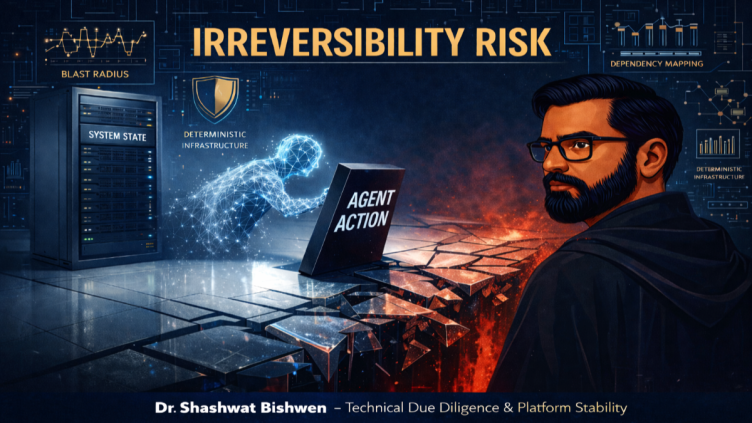
We are witnessing a profound and dangerous category error across technology boardrooms and venture diligence: treating Agentic AI as if it were simply another microservice tier.
In traditional software engineering, if a bad deployment introduces a bug, the rollback protocol is straightforward: git revert, flush cache, and restore state from backup.
With autonomous agentic systems endowed with tool execution and API dispatch authority, there is no git revert.
When an autonomous agent mistakenly liquidates a trading position, dispatches emergency pharmaceuticals in a hospital workflow, or commits a legal contract via external webhook, the action immediately alters external physical and financial reality.
During technical due diligence in 2026, inspecting prompt templates and evaluation benchmarks is completely insufficient.
Investors and CTOs must forensically audit the containment topology: Are agent actions bounded by cryptographic multi-party authorization? Are financial write operations gated by deterministic escrow? If not, the company is carrying an existential unhedged liability.
Monk, Author, TEDx Speaker, and Solution Assembler. For 23 years quietly stabilizing platforms, eliminating operational drag, and making broken systems predictable.